

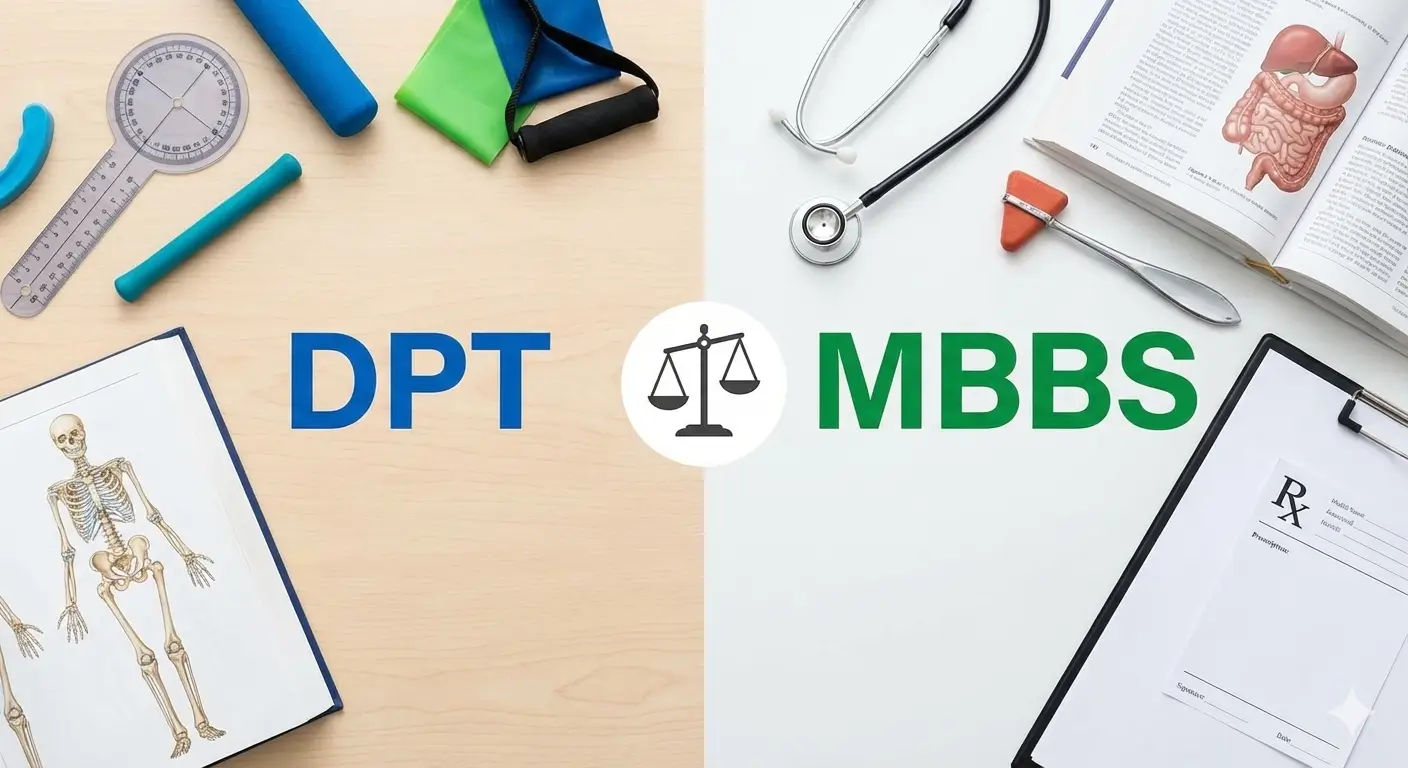
It’s crucial to understand that both DPT (Doctor of Physical Therapy) and MBBS (Bachelor of Medicine, Bachelor of Surgery) are valuable clinical careers, each serving unique purposes. MBBS is a general medical degree that teaches you how to become a health professional who can diagnose and treat a wide range of illnesses, perform surgeries, and work in hospitals or clinics. DPT focuses specifically on physical therapy, supporting patients to get over injuries, improve movement, and manage pain through exercises and treatments. The question of “Comparing DPT and MBBS: Which One is Better?” would not have an effortless answer, as it depends on your pursuits and career goals. If you have experience supporting human beings with movement problems and rehabilitation, DPT might be better for you. MBBS will be the ideal choice if you wish to diagnose illnesses and provide renowned hospital therapy. Both fields offer excellent job opportunities and the chance to help people improve their health, so the “better” option is really the one that matches your personal interests and strengths.
Unlock Global Opportunities with the Best DPT & MBBS Degree programs
When searching out the best DPT and MBBS degree programs, there are several essential elements you should not forget. Good applications require experienced teachers, modern centres, and sturdy connections with hospitals, so students can get hands-on practice. For MBBS programs, look for colleges that provide medical education in nicely equipped hospitals and have an amazing reputation for producing skilled medical doctors. For DPT programs in Lahore, choose faculties that provide realistic experience with real patients and have up-to-date gadgets for physical remedy education. The best DPT and MBBS degree programs also boast high pass rates for licensing exams and reliable job placement statistics for their graduates. Additionally, accreditation from recognized medical schooling boards is essential for each type of program. Whether you pick DPT or MBBS, ensure the program fits your budget, area choices, and career goals. Research unique colleges, read reviews from former students, and visit campuses if possible to identify a system that will offer you top-notch education and adequately prepare you for your future scientific career.
Career Scope and Curriculum: Difference Between the DPT Degree and the MBBS Degree
The main difference between a DPT degree and an MBBS degree is in what they focus on, what students learn, and the career paths they lead to in healthcare. While each is a doctoral-stage healthcare program, the MBBS (Bachelor of Medicine, Bachelor of Surgery) prepares college students to grow into clinical doctors with vast diagnostic and treatment skills across all clinical specialities, such as the authority to prescribe medications, order diagnostic tests, and perform surgical techniques. In comparison, the scope of DPT is specifically in movement dysfunction, rehabilitation, and healing interventions that specialise in restoring patients’ practical mobility and decreasing ache through proof-based bodily treatments. The educational pathways also vary significantly: MBBS programs typically last 5-6 years and include extensive clinical rotations across various medical disciplines, while DPT programs are usually completed in 4 years after finishing prerequisite coursework that focuses on anatomy, biomechanics, therapeutic exercises, and guided treatment techniques. Understanding the difference between a DPT degree and an MBBS degree is essential for college kids deciding on their healthcare career route, as every career serves wonderful, however complementary, roles in affected person care and recuperation.
Which Is Better for You, MBBS or DPT?
When considering what’s better for you, MBBS or DPT, the DPT program often emerges as the advanced choice for individuals obsessed with rehabilitation, motion science, and making an immediate, hands-on impact on patients’ quality of life. The DPT program gives a more targeted instructional pathway with a shorter duration (3 years as opposed to 5–6 years for MBBS), allowing you to join the group of workers sooner while nevertheless earning a doctoral-degree diploma. DPT experts experience excellent task protection with an 18% growth fee—appreciably better than most medical specialities—and the profession gives superb flexibility in work settings, from hospitals and outpatient clinics to sports centres and domestic health care. Unlike the high-stress, life-or-death decisions frequently required in scientific practice, DPT work makes a speciality of empowering patients through healing interventions and functional improvement. Additionally, the DPT discipline presents various specialised opportunities in orthopaedics, neurology, paediatrics, and sports. While MBBS offers higher income potential and broader medical authority, the question of whether MBBS or DPT is better for you ultimately depends on your personal interests; however, for those seeking meaningful patient relationships, modern treatment techniques, and a growing field with excellent career opportunities, DPT is an increasingly attractive and profitable choice in healthcare.
Comparing Table DPT vs. MBBS
| Aspect | DPT Degree | MBBS Degree |
| Full Form | Doctor of Physical Therapy | Bachelor of Medicine, Bachelor of Surgery |
| Duration | 4 years (post-bachelor’s) | 5-6 years (undergraduate medical program) |
| Prerequisites | Bachelor’s degree with science courses | High school completion with strong science background |
| Primary Focus | Movement dysfunction, rehabilitation, therapeutic interventions | Comprehensive medical diagnosis, treatment, and surgery |
| Scope of Practice | Physical therapy treatments, movement assessment, pain management | Full medical practice including diagnosis, prescription, surgery |
| Prescriptive Authority | Limited (varies by state/country) | Full prescriptive authority for medications |
| Diagnostic Capabilities | Movement and functional assessments | Complete medical diagnosis using various tests and procedures |
| Clinical Training | Rehabilitation centers, outpatient clinics, sports facilities | Hospitals, clinics, various medical specialties |
| Core Subjects | Anatomy, Biomechanics, Therapeutic Exercise, Manual Therapy | Anatomy, Physiology, Pathology, Pharmacology, Surgery |
| Patient Population | Patients with movement disorders, injuries, chronic pain | All types of patients across all age groups and conditions |
| Work Settings | Hospitals, outpatient clinics, sports centers, home health | Hospitals, private practice, clinics, emergency departments |
| Average Salary Range | 85,000 – 120,000 | 200,000 – 400,000+ (varies by specialty) |
| Specialization Options | Orthopedics, Neurology, Pediatrics, Sports, Geriatrics | 40+ medical specialties (Cardiology, Surgery, Pediatrics, etc.) |
| Licensing Exam | National Physical Therapy Examination (NPTE) | USMLE (US) or equivalent medical licensing exams |
| Residency Requirement | Optional (1-year residencies available) | Mandatory (3-7 years depending on specialty) |
| Research Component | Often includes capstone project or thesis | Research opportunities but not always mandatory |
| Continuing Education | Required for license renewal | Required for license renewal and board certification |
| Job Growth Outlook | 18% (much faster than average) | 3% (slower than average, varies by specialty) |
| Patient Interaction | Long-term therapeutic relationships | Varies from brief consultations to long-term care |
| Treatment Approach | Non-invasive, exercise-based, manual therapy | Medical, surgical, pharmacological interventions |
| Healthcare Team Role | Rehabilitation specialist, movement expert | Primary care provider or specialist physician |
| International Recognition | Varies by country | Widely recognized globally |
| Admission Requirements | For DPT admission in Lahore GRE scores, prerequisite courses, clinical experience | MCAT scores, extensive prerequisites, volunteer experience |
| Technology Use | Movement analysis, therapeutic modalities | Advanced diagnostic equipment, surgical technology |
| Patient Outcomes Focus | Functional improvement, pain reduction, mobility | Disease cure, symptom management, life preservation |
FAQs
The primary distinction lies in scope and specialisation.programs are generally three MBBS is a comprehensive medical degree that prepares students to become doctors with broad diagnostic and treatment capabilities, including prescribing medications and performing surgeries. DPT (Doctor of Physical Therapy) is a specialised healthcare degree focused specifically on movement dysfunction, rehabilitation, and therapeutic interventions to restore patients’ functional mobility and reduce pain.
MBBS typically takes longer, requiring 5-6 years of undergraduate medical education followed by mandatory residency training (3-7 years depending on speciality). DPT programmes are generally 3 years in duration but require a completed bachelor’s degree with prerequisites. courses beforehand. Overall, you can start practicing as a physical therapist sooner than as a physician.
No, DPT graduates have limited or no prescriptive authority in most jurisdictions, while MBBS graduates have full prescriptive authority for medications. However, some states and countries are expanding the DPT's scope of practice to include limited prescriptive rights for certain medications related to physical therapy treatment.
MBBS graduates generally earn higher salaries, with physicians averaging $200,000–$400,000+, depending on speciality. DPT professionals typically earn between 85,000 and 120,000. However, DPT offers faster entry into the workforce and excellent job security with 18% projected growth compared to 3% for physicians.
Both require strong science foundations, but MBBS demands more extensive prerequisites, including advanced chemistry, physics, biology, and mathematics. DPT programs require science courses but are generally more accessible, with prerequisites like anatomy, physiology, psychology, and statistics being sufficient for most.
DPT significantly outpaces MBBS in job growth, with an 18% projected increase compared to 3% for physicians. The ageing population, increased awareness of rehabilitation benefits, and expansion of physical therapy services into new healthcare settings drive this growth in the DPT field.
Indeed, the situation does differ. MBBS graduates can pursue more than 40 medical specialities through residency programs lasting 3–7 years. DPT graduates can specialise through optional 1-year residency programmes or board certifications in areas like orthopaedics, neurology, paediatrics, sports medicine, and geriatrics.
DPT generally provides better work-life balance with more predictable schedules, fewer emergency calls, and fewer on-call requirements. Physical therapists typically work standard business hours in outpatient settings, while physicians often face irregular schedules, night shifts, and emergency responsibilities.
MBBS has broader international recognition and easier transferability between countries. DPT recognition varies by country, with some nations requiring additional certification or education for foreign-trained physical therapists to practice locally.
Both can help with injury recovery, but in different ways. Choose DPT if you want to focus specifically on rehabilitation, therapeutic exercise, manual therapy, and helping patients regain function through hands-on treatment. Choose MBBS if you prefer diagnosing injuries, performing surgeries, prescribing medications, and having broader medical authority in injury management. DPT offers patients more specialised, long-term therapeutic relationships during their recovery journeys.
